Blog
Upwind Blog
Feed
Grid
PHP2Shell: Inside the Two Critical PHP RCE Flaws

Two critical remote-code-execution flaws in PHP (CVE-2026-109618 and CVE-2026-109619) were patched on 21 October 2026. What we found: the public "php2shell" exploit targets the wrong bug, the real flaw is engine-wide, and the loud "the patch is already broken" claims do not hold up. TL;DR On 21 October 2026 the PHP project shipped emergency fixes…
LiteLLM 1.107.0 Supply Chain Attack: How a Hijacked Release Pipeline Signed Malicious Code
TL;DR On October 21, 2026, Upwind identified a supply chain compromise in LiteLLM, the popular open-source AI gateway, with ~22.8 million weekly PyPI downloads. Version 1.107.0 was published to PyPI and to Docker Hub/GHCR containing a credential stealer and a remote code loader. We were the first to report it publicly, in BerriAI/litellm#47826 and on…
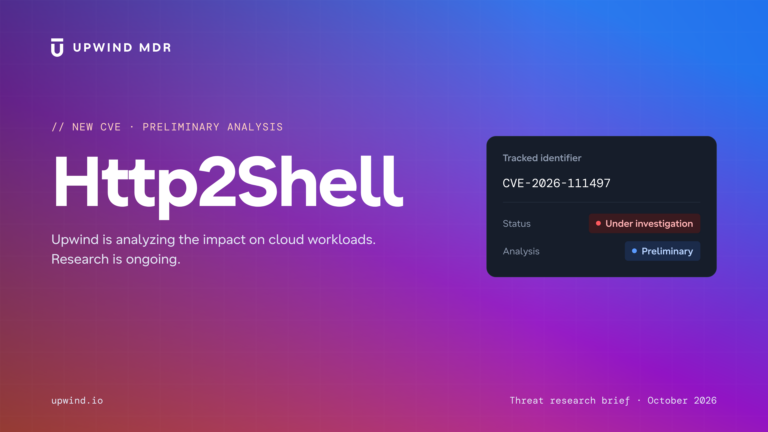
HTTP2Shell (CVE-2026-111497): one Brotli bug, RCE across the HTTP stack
TL;DR HTTP2Shell (CVE-2026-111497) is an out-of-bounds write in Google's Brotli decoder, versions 1.0.3 through 1.2.0. An unauthenticated attacker who gets crafted Brotli data into a vulnerable decoder can crash the process, read its memory, or in some cases run code. It was first reported as a Node.js bug ("Node2Shell"), but the flaw is in the…
The context gap: what runtime context changes in cloud and AI security


Key takeaways Most cloud security teams can see their environment. Inventory is broad, scanners run on schedule and findings pile up. What they can't tell you is which of those findings matter right now. That's the context gap. Visibility was the right foundation, and most programs have built it (see where yours sits on the…
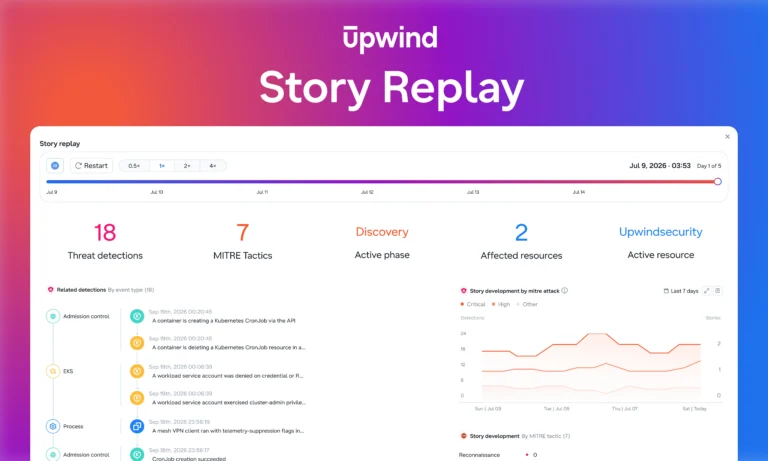
Upwind Story Replay: Watch the Attack Unfold

Upwind Story Replay is now available in Upwind: a visual timeline of the detections that led to a threat. Click a threat story, watch the attack unfold step by step. Three Vectors in One Week AI is accelerating everything we knew about supply chain attacks, zero-days, and finding new critical CVEs. Attacks are unfolding fast…
eMudhra CA Compromise: What Cloud Security Teams Need to Know


Executive summary On October 17, a researcher reported control of eight eMudhra intermediate certificate authority private keys. Mozilla independently recovered the keys and confirmed that their generation was flawed. The technical finding is severe: the affected P-384 private keys were integers below 256, making them trivially recoverable from public information. Describing this simply as a…
LiteLLM 1.107.0 Supply Chain Attack: Malicious Code Found in PyPI Package
TL;DR A supply chain security investigation has identified malicious code in LiteLLM version 1.107.0, a Python package distributed through PyPI. The affected package contains multiple files designed to execute code automatically when Python starts, retrieve attacker-controlled payloads, and maintain persistent access to compromised environments. Based on the analyzed package, this should be treated as a…
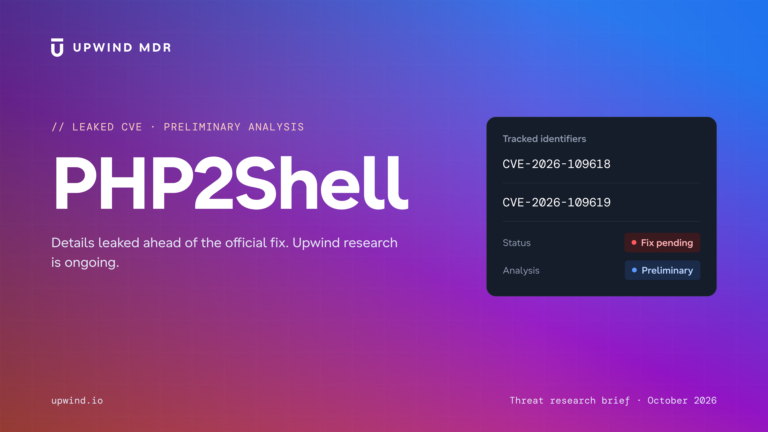
PHP2Shell: Two Critical Unpatched PHP RCEs (CVE-2026-109618 & CVE-2026-109619) – Update
TL;DR PHP has released emergency fixes for two critical memory-corruption vulnerabilities, CVE-2026-109618 and CVE-2026-109619. Both allow unauthenticated remote code execution on default configurations. Details were leaked before the coordinated disclosure, which forced an accelerated release. Update to PHP 8.5.12, 8.4.27, 8.3.36 or 8.2.35 now. UPDATE: Now Official With Patch Versions UPDATE (October 21, 2026 14:00…

Runtime First, Agentless Everywhere
TL;DR Kubernetes has taken on a second job. Clusters still run the applications they always ran, but now they also run AI agents, model-serving workloads, and MCP servers alongside the applications those agents work on. These workloads do not behave like the applications Kubernetes was built to run. They call tools, reach external services, and…
Upwind Launches Databricks Security for Lakehouse Data and AI

Databricks permissions now trace to the cloud resources they actually reach. Ask a Databricks admin who can read a given catalog and you'll get an answer. Ask what that access reaches in your cloud account and nobody can tell you, because Databricks doesn't track it. Unity Catalog ends at the storage credential, and what sits…

Can AI Agents Safely Remediate Cloud Misconfigurations? We Tested 12 Models.


Introduction Teams are starting to let AI agents fix their cloud findings. What nobody has measured is whether those changes are safe to run. So we built a live AWS account, broke it on purpose in eighteen ways that chain into nine attack paths, and gave twelve AI models read-only access to it with one…
Upwind x Cursor Origin – Securing Software Factories

Upwind is partnering with Cursor Origin to secure every change pushed to the repository, whether a human or an agent wrote it. Upwind now scans code in Origin. Every pull request and every push to the default branch is checked automatically, with findings delivered as pull request comments, checks, and alerts in the Upwind console.…
PHP2Shell: Two Critical Unpatched PHP RCEs (CVE-2026-109618 & CVE-2026-109619) – Update
TL;DR PHP has released emergency fixes for two critical memory-corruption vulnerabilities, CVE-2026-109618 and CVE-2026-109619. Both allow unauthenticated remote code execution on default configurations. Details were leaked before the coordinated disclosure, which forced an accelerated release. Update to PHP 8.5.12, 8.4.27, 8.3.36 or 8.2.35 now. UPDATE: Now Official With Patch Versions UPDATE (October 21, 2026 14:00…
Latest
October 26, 2026
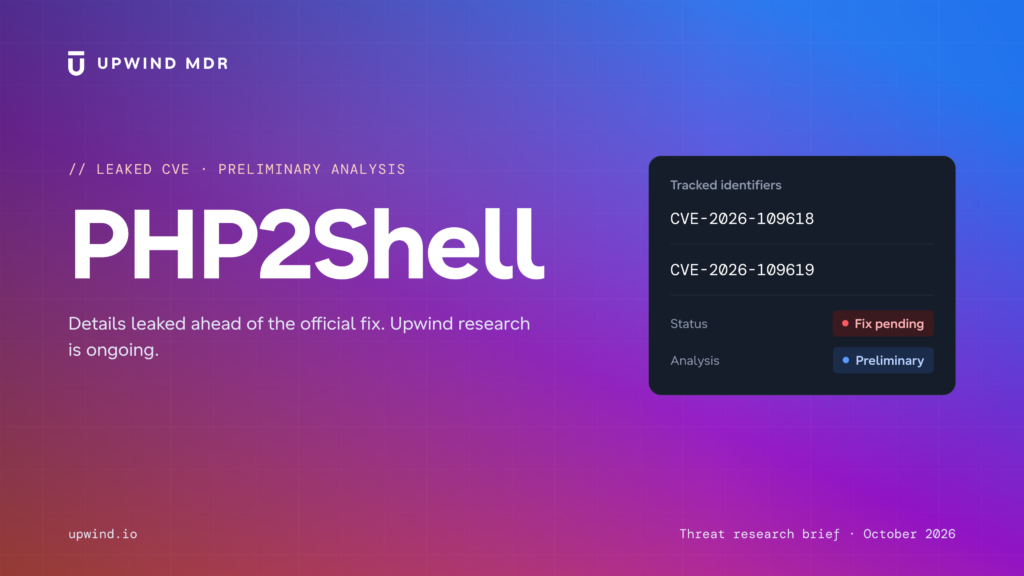
PHP2Shell: Inside the Two Critical PHP RCE Flaws
Two critical remote-code-execution flaws in PHP (CVE-2026-109618 and CVE-2026-109619) were patched on 21 October 2026. What we found: the public "php2shell" exploit targets the wrong bug, the real flaw is engine-wide, and the loud "the patch is already broken" claims do not hold up. TL;DR On 21 October 2026 the PHP project shipped emergency fixes…
October 26, 2026
LiteLLM 1.107.0 Supply Chain Attack: How a Hijacked Release Pipeline Signed Malicious Code
TL;DR On October 21, 2026, Upwind identified a supply chain compromise in LiteLLM, the popular open-source AI gateway, with ~22.8 million weekly PyPI downloads. Version 1.107.0 was published to PyPI and to Docker Hub/GHCR containing a credential stealer and a remote code loader. We were the first to report it publicly, in BerriAI/litellm#47826 and on…
October 24, 2026
HTTP2Shell (CVE-2026-111497): one Brotli bug, RCE across the HTTP stack
TL;DR HTTP2Shell (CVE-2026-111497) is an out-of-bounds write in Google's Brotli decoder, versions 1.0.3 through 1.2.0. An unauthenticated attacker who gets crafted Brotli data into a vulnerable decoder can crash the process, read its memory, or in some cases run code. It was first reported as a Node.js bug ("Node2Shell"), but the flaw is in the…
October 22, 2026
The context gap: what runtime context changes in cloud and AI security
Key takeaways Most cloud security teams can see their environment. Inventory is broad, scanners run on schedule and findings pile up. What they can't tell you is which of those findings matter right now. That's the context gap. Visibility was the right foundation, and most programs have built it (see where yours sits on the…
October 21, 2026
Upwind Story Replay: Watch the Attack Unfold
Upwind Story Replay is now available in Upwind: a visual timeline of the detections that led to a threat. Click a threat story, watch the attack unfold step by step. Three Vectors in One Week AI is accelerating everything we knew about supply chain attacks, zero-days, and finding new critical CVEs. Attacks are unfolding fast…
October 21, 2026
eMudhra CA Compromise: What Cloud Security Teams Need to Know
Executive summary On October 17, a researcher reported control of eight eMudhra intermediate certificate authority private keys. Mozilla independently recovered the keys and confirmed that their generation was flawed. The technical finding is severe: the affected P-384 private keys were integers below 256, making them trivially recoverable from public information. Describing this simply as a…
October 21, 2026
LiteLLM 1.107.0 Supply Chain Attack: Malicious Code Found in PyPI Package
TL;DR A supply chain security investigation has identified malicious code in LiteLLM version 1.107.0, a Python package distributed through PyPI. The affected package contains multiple files designed to execute code automatically when Python starts, retrieve attacker-controlled payloads, and maintain persistent access to compromised environments. Based on the analyzed package, this should be treated as a…
October 19, 2026
Runtime First, Agentless Everywhere
TL;DR Kubernetes has taken on a second job. Clusters still run the applications they always ran, but now they also run AI agents, model-serving workloads, and MCP servers alongside the applications those agents work on. These workloads do not behave like the applications Kubernetes was built to run. They call tools, reach external services, and…
October 19, 2026
Upwind Launches Databricks Security for Lakehouse Data and AI
Databricks permissions now trace to the cloud resources they actually reach. Ask a Databricks admin who can read a given catalog and you'll get an answer. Ask what that access reaches in your cloud account and nobody can tell you, because Databricks doesn't track it. Unity Catalog ends at the storage credential, and what sits…
October 19, 2026
Can AI Agents Safely Remediate Cloud Misconfigurations? We Tested 12 Models.
Introduction Teams are starting to let AI agents fix their cloud findings. What nobody has measured is whether those changes are safe to run. So we built a live AWS account, broke it on purpose in eighteen ways that chain into nine attack paths, and gave twelve AI models read-only access to it with one…
October 13, 2026
Upwind x Cursor Origin – Securing Software Factories
Upwind is partnering with Cursor Origin to secure every change pushed to the repository, whether a human or an agent wrote it. Upwind now scans code in Origin. Every pull request and every push to the default branch is checked automatically, with findings delivered as pull request comments, checks, and alerts in the Upwind console.…
October 12, 2026
The State of AI Security for Endpoints

A first look at 10,000 workstations We analyzed AI agent activity across 10,000 workstations at Upwind customers in the United States and Europe. This post is a sneak peek at the findings ahead of the full report. The short version: agent adoption has already moved past the point where an approval process can catch up…